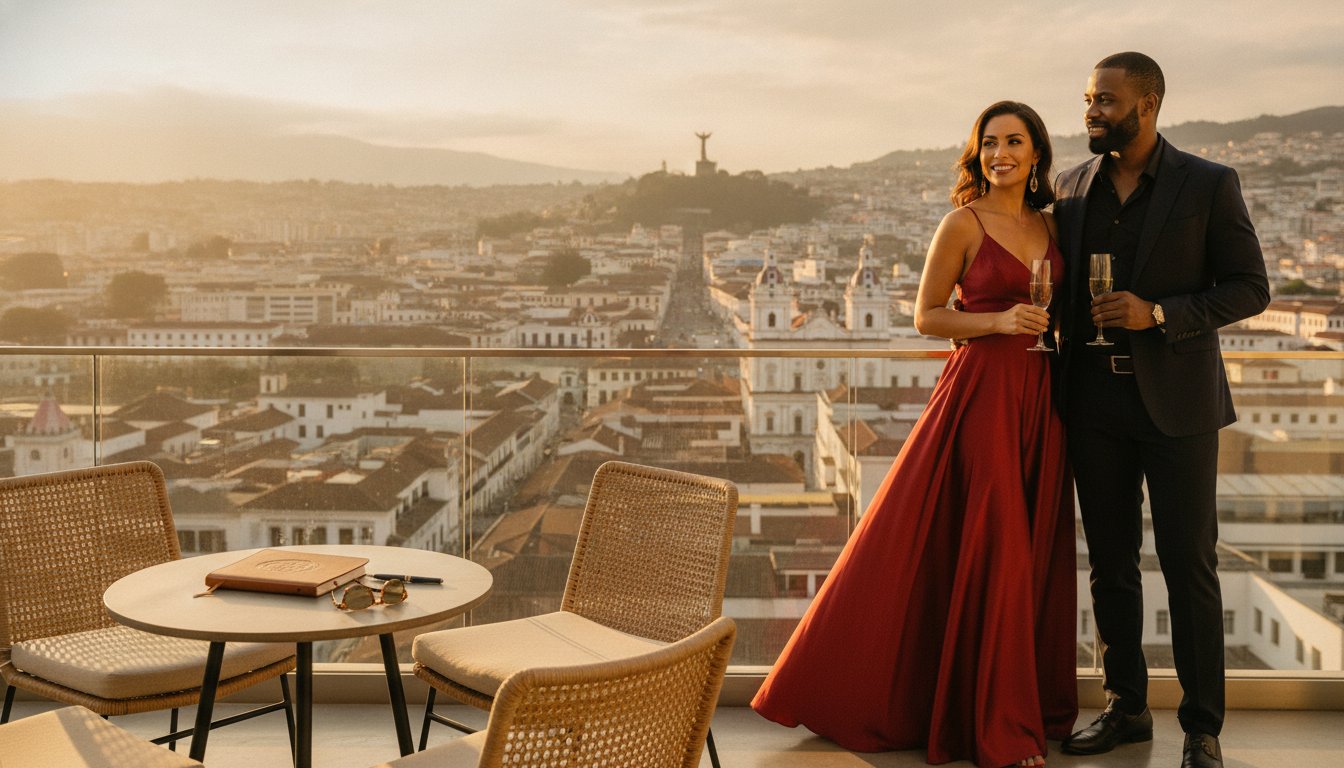
You can stand with one foot in each hemisphere and then watch the sunset over the Pacific, all before the day is done. It’s a rare kind of magic that only Ecuador offers. We know that the excitement of exploring the Amazon or the Galapagos is often tempered by the stress of planning. You might worry about altitude sickness in the Andes or feel uncertain about navigating safety in bustling urban centers. That’s why many savvy travelers turn to Simply Elite Travel & Tours for Ecuador group travel packages to provide a protective shield against the chaos of logistics.
We’ve curated this essential 2026 checklist to transform your travel anxiety into pure anticipation. You’ll master the non-negotiables, from ensuring your passport is valid for six months to preparing the $200 cash fee for the Galapagos National Park. This guide walks you through health preparations, currency quirks, and the mandatory $20 Transit Control Card. Prepare for a worry-free itinerary where every detail is meticulously organized; this roadmap ensures you’re ready to connect deeply with the heart of South America.
Key Takeaways
- Verify that your passport remains valid for at least six months beyond your arrival date to meet strict entry requirements.
- Prepare for the diverse climates of the “Four Worlds” by packing versatile layers that transition from the cool Andean highlands to the humid Amazon.
- Prioritize your health and security by using bottled water and following expert local guidance to navigate urban centers with confidence.
- Learn how Ecuador group travel packages provide a protective shield against logistical stress, offering a seamless journey through Quito, Cuenca, and beyond.
- Carry small denominations of clean, crisp US dollars to ensure effortless transactions at local markets where larger or damaged bills are often refused.
Entry Requirements and Essential Logistics for 2026
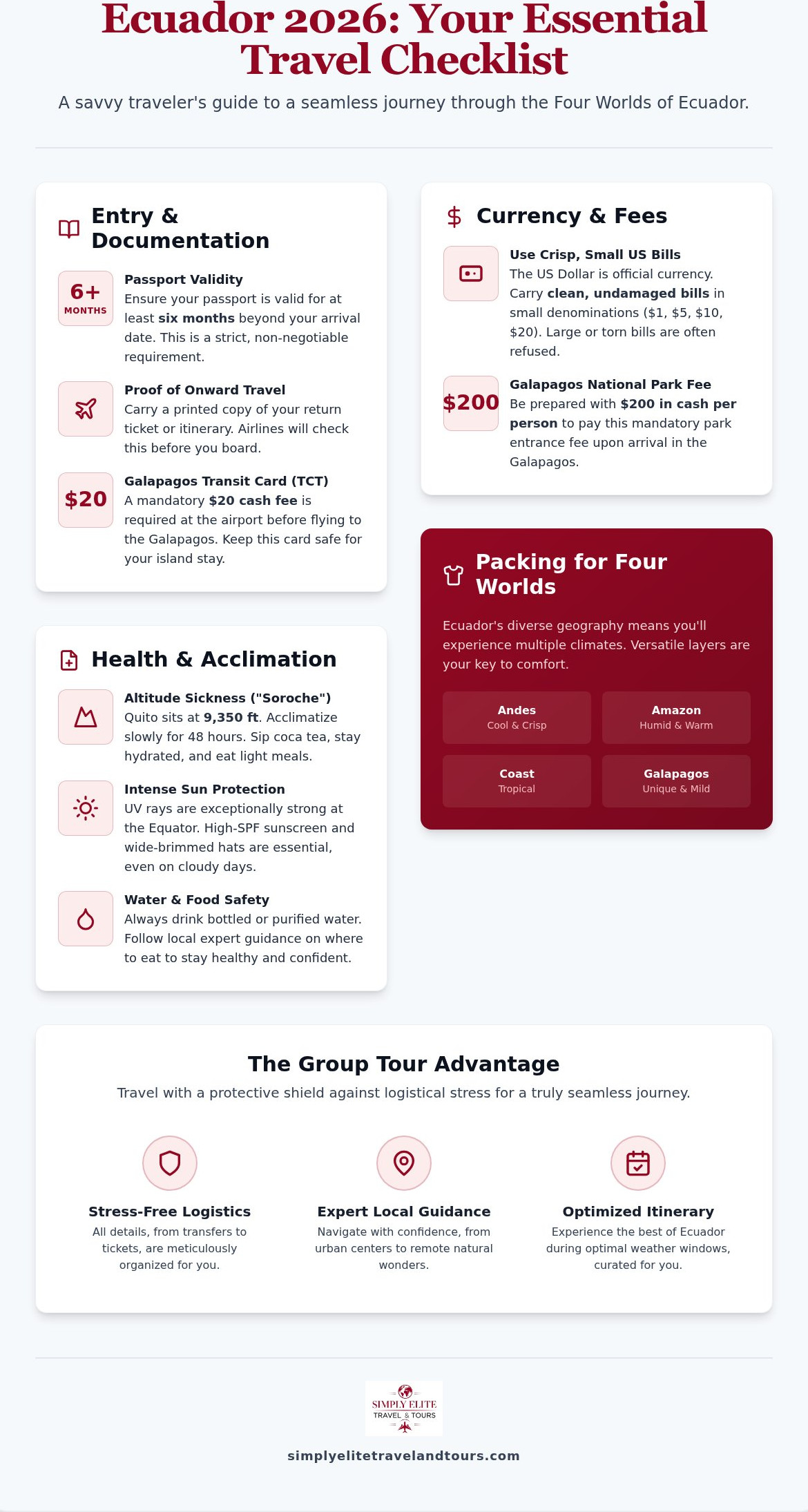
Your journey to the center of the world begins long before you touch down in Quito. Success starts with a passport valid for at least six months beyond your entry date. This is a strict requirement that officials monitor closely. While most Western travelers don’t need a visa for stays under 90 days, airline staff will almost certainly ask for proof of onward travel during check-in. Carry a confirmed return ticket or a printed itinerary for your next destination to ensure a smooth start to your adventure. These simple steps act as the foundation for a seamless experience from the moment you leave home.
By 2026, comprehensive travel protection has evolved into a standard expectation for curated tours. It serves as a vital safety net, covering everything from sudden medical needs at high altitudes to unexpected flight interruptions. Understanding the Geography and climate of Ecuador helps you realize why this matters. Moving between the crisp Andean peaks and the lush Amazon basin involves shifting logistics, and having professional coverage ensures you remain focused on the discovery rather than the “what-ifs.” It’s about providing a protective shield so your focus remains on the magic of the destination.
The 2026 Visa and Documentation Checklist
Maintain both digital and physical copies of your travel documents throughout your stay. While digital backups are helpful, local officials in historic Quito often prefer to see physical proof of your entry status. For those participating in faith-based or corporate missions, our dedicated Travel Protection & Visa Assistance service streamlines these complex group entries. Choosing specialized Ecuador group travel packages often includes this level of detail-oriented support, making the entire documentation process feel light and manageable. Travelers heading to the Galapagos must also secure a Transit Control Card (TCT) for $20 at the airport before departure. This document is a mandatory part of the archipelago’s conservation efforts and must be kept safe until you leave the islands.
Customs and Border Logistics
Moving through Mariscal Sucre International Airport is a breeze when you arrive prepared. Declare any professional-grade electronics or high-value items to avoid unnecessary complications with customs duties later. Strict agricultural laws protect the country’s biodiversity, so never attempt to bring fresh produce or organic materials into the Galapagos. To ensure a truly effortless arrival, we recommend utilizing pre-arranged transfers. By selecting one of our Ecuador group travel packages, you gain the benefit of a seasoned navigator who meets you at arrivals. This whisking away to your hotel while others are still negotiating with local transport is the hallmark of a well-planned itinerary. Trust in the expertise of those who have handled these details for decades to make your arrival both welcoming and efficient.
Geography and Climate: Packing for Four Worlds
Ecuador is essentially four distinct countries woven into one vibrant tapestry. You have the volcanic peaks of the Andes, the dense canopy of the Amazon, the tropical Coast, and the prehistoric magic of the Galapagos. Because of this geographical diversity, the weather is rarely uniform across the regions. In high-altitude cities like Quito, you’ll experience four seasons in a single afternoon. The morning sun might feel like a bright summer day, while a late afternoon downpour brings the crisp chill of autumn. Understanding the CDC health recommendations for Ecuador is a great first step, especially regarding sun safety. At the Equator, UV rays are exceptionally intense even on cloudy days. High-SPF protection and wide-brimmed hats aren’t just suggestions; they’re essential tools for your physical well-being.
Timing your “Ecuador Uncovered” adventure for the optimal 2026 weather window ensures you see the landscape at its best. While the wet and dry seasons vary by region, professional Ecuador group travel packages are scheduled to maximize clear views of Cotopaxi and comfortable trekking conditions in the rainforest. This careful curation removes the guesswork from your planning, allowing you to focus on the discovery rather than the forecast. It’s about arriving with the right gear and the right expectations for a truly seamless experience.
Altitude Acclimation in the Andes
Success in the highlands starts with a slow and steady pace. Quito sits at roughly 9,350 feet, while Cuenca is slightly lower at about 8,400 feet. This elevation difference impacts your body during the first 48 hours. Many travelers feel “soroche,” or altitude sickness, as a slight headache or shortness of breath. To combat this, sip on local coca tea and stick to light, easily digestible meals for your first few dinners. Hydration is your best friend here. We pace our itineraries to allow your body to adjust naturally, ensuring you feel energized for the cobblestone streets of the historic centers rather than fatigued by the thin air.
Packing Essentials for Diverse Regions
Versatility is the golden rule for your suitcase. You’ll need a lightweight, high-quality rain poncho for the misty waterfalls of Banos and breathable, sun-protective shirts for a Galapagos Islands tour. Your footwear choice is equally critical. Invest in sturdy, broken-in hiking boots to handle volcanic trails and uneven colonial pavements with ease. The “onion method” of layering serves as the golden rule for 2026 travelers because it allows for instant adjustments as the Andean sun gives way to evening mountain chills. If you’re ready to see these four worlds for yourself, explore our curated Ecuador itineraries to find the perfect fit for your next big milestone.
Health, Safety, and Group Security
Your physical well-being is the cornerstone of a transformative travel experience. In Ecuador, locals often use the phrase “no dar papaya,” which literally means “don’t give the papaya.” It’s a colorful way of saying you shouldn’t make yourself an easy target. Practice this by keeping your valuables discreet and staying aware of your surroundings in busy plazas. While the spirit of adventure is vital, your safety comes first. Prioritizing these small habits allows you to explore with a sense of freedom rather than fear.
Health protocols remain a dynamic part of international travel in 2026. Always check the UK government travel advice for Ecuador for the most recent updates on vaccination requirements and local safety advisories. For those venturing into the Amazonian provinces, a yellow fever vaccination is highly recommended and should be administered at least 10 days before you arrive. Water safety is another non-negotiable factor. Stick strictly to bottled or filtered water for drinking and even for brushing your teeth if you have a sensitive system. Most high-end hotels and curated tours provide ample purified water to keep you hydrated and healthy.
Choosing professional Ecuador group travel packages offers a distinct security advantage over solo exploration. Traveling with a vetted organization means you’re never truly alone in navigating local complexities. Our guides act as a protective shield, using their deep local knowledge to steer the group away from areas of concern and toward the most authentic, secure experiences. This collective approach doesn’t just enhance safety; it builds a community of like-minded adventurers who look out for one another.
Navigating Cities with Confidence
Movement within cities like Quito and Guayaquil requires a strategic approach. Always use registered taxis or pre-arranged tour transfers rather than hailing a car on the street. In Guayaquil, safety conditions can vary significantly by district, so we focus our exploration on secure, vibrant areas like the Malecon 2000. When evening falls, enjoy the dining scenes in well-lit, popular neighborhoods like La Mariscal or Cumbaya. Our “Trusted Expert Navigator” philosophy ensures that every evening excursion is planned with your security as the top priority, allowing you to soak in the local culture without worry.
Health Preparation and Insurance
Schedule a pre-trip medical consultation to discuss your specific health needs for the Andes and the Amazon. While we previously discussed altitude acclimation, your physician can provide tailored advice for tropical environments. We strongly recommend our Travel Protection & Visa Assistance to ensure you have comprehensive coverage, including medical evacuation. This is particularly critical for remote adventures in the Galapagos or the rainforest. Carry a small personal medical kit with basics like antihistamines, rehydration salts, and any personal prescriptions to maintain your comfort in every environment. Preparation is the key to a worry-free “Ecuador Uncovered” journey.
Money, Connectivity, and Cultural Etiquette
Since 2000, Ecuador has used the US Dollar as its official currency. This makes the financial transition incredibly easy for North American travelers. You won’t need to worry about exchange rates or confusing mental math at the dinner table. However, the local economy runs on small bills. Carrying a stack of $1, $5, and $10 bills is essential for buying artisanal crafts or paying for a quick snack in a rural market. Larger bills like $20s or $50s are often met with a shake of the head because change is frequently in short supply. Choosing high-quality Ecuador group travel packages means your logistics are handled, but having small cash on hand remains your responsibility for personal purchases.
Connectivity in 2026 is better than ever, yet it still requires a plan. International roaming plans are convenient but can be sluggish in the high-altitude Andes. For the most reliable signal, many travelers opt for a local SIM card from providers like Claro or Movistar. This ensures you can share your photos of the Amazon canopy or the historic streets of Cuenca in real-time. It’s about staying connected to home while fully immersing yourself in the magic of the moment. We recommend downloading offline maps of Quito and Guayaquil as a backup to ensure you always feel oriented.
The Cash Economy and Tipping
While the paper money is identical to what you use in the States, keep an eye on your coins. Ecuador mints its own centavos that share the same size and value as US coins. You’ll likely receive a mix of both in your change. Don’t worry; they are fully interchangeable within the country. When it’s time to show appreciation for the service you’ve received, remember that tipping is a vital part of the local tourism economy. Providing a daily propina for group tour leaders and drivers ensures these dedicated professionals are fairly compensated for their expert care and knowledge. Generally, 10% is standard in restaurants, though many upscale establishments in Quito already include a service charge.
Cultural Nuances and Etiquette
Embracing the local rhythm of life is part of the transformation. You might encounter the “mañana” concept, where schedules feel more fluid than in the frantic pace of Western cities. Approach these moments with a smile and a little patience. In the traditional Andean highlands, formal greetings are the key to building rapport. A simple “Buenos días” or “Buenas tardes” goes a long way in establishing a friendly connection with locals. Respect is the most important item in your travel kit. If you wish to photograph the vibrant indigenous people in their traditional dress, always ask for permission first. It’s a small gesture that honors their dignity and culture. If you’re ready to experience this deep connection for yourself, book one of our Ecuador group travel packages to begin your journey with confidence and ease.
Why a Curated Tour is the Ultimate Way to See Ecuador
Explore the Andes without the white-knuckle stress of mountain driving. While some guides suggest car rentals for the sake of flexibility, they often ignore the reality of navigating steep Andean passes, sudden landslides, and complex local traffic laws. Moving from Quito to Cuenca on your own can quickly lead to exhaustion rather than inspiration. Our Ecuador group travel packages offer a more refined alternative. Imagine leaning back in a comfortable seat while a professional driver handles the hairpin turns of the Pan-American Highway. This allows you to soak in the views of the Avenue of the Volcanoes rather than gripping a steering wheel in a foreign landscape.
Expert storytelling transforms a simple sightseeing stop into a deep connection with history. In the misty hills of Banos or the vibrant streets of Guayaquil, our local guides share the narratives that generic guidebooks miss. This level of insight is the Simply Elite difference. We’ve spent over 30 years mastering the nuances of this region, positioning ourselves as your Trusted Expert Navigator since 1994. Our “Ecuador Uncovered” itinerary isn’t just a route; it’s a carefully orchestrated experience designed to show you the heart of the country with absolute ease.
The Value of Professional Planning
Logistical fatigue is a very real threat to any ambitious itinerary. We manage every transfer, hotel check-in, and site entry to ensure your momentum never slows. This professional oversight is particularly valuable for faith-based and corporate groups where the focus should remain on the mission rather than the mechanics of the trip. We also handle the intricate maritime logistics of the Galapagos Islands, ensuring your transition from the mainland to the archipelago is completely seamless. By acting as a protective shield between you and the potential chaos of planning, we ensure your energy is reserved for discovery.
Your Next Steps to Discovery
Ready to turn your curiosity into a final decision? Booking your 2026 adventure is a straightforward process designed to build anticipation. Our “worry-free” philosophy means we have everything handled, allowing you to approach your journey with confidence. Experience the transformation that comes from a perfectly planned itinerary and the security of a seasoned travel partner. You’re not just visiting a destination; you’re embarking on a meaningful life milestone with experts who genuinely care about your satisfaction.
View our Ecuador Uncovered itinerary and start planning today!
Step Into Your Ecuadorian Discovery
You’ve now mastered the essential logistics for 2026. From understanding the strict six-month passport rule to navigating the unique currency of the Andes, you possess the knowledge to travel with absolute confidence. You’re ready to pack for the “Four Worlds” and engage with local customs with genuine respect and curiosity. This preparation ensures that your focus remains on the breathtaking landscapes and cultural connections rather than the paperwork.
Since 1994, Simply Elite Travel & Tours has acted as a trusted navigator for those seeking deeper, more meaningful connections. We specialize in faith-based and group travel management, providing comprehensive visa and protection support to ensure your journey is as smooth as it is transformative. Our Ecuador group travel packages are designed to remove the weight of planning from your shoulders, acting as a protective shield against logistical fatigue. Every detail is handled with precision so you can focus on the magic of the Galapagos or the colonial history of Quito.
Start your worry-free Ecuador adventure with Simply Elite Travel & Tours and embrace the ease that only professional curation can provide. Your journey to the center of the world is within reach, and we’re here to guide every step of the way. Let’s make your 2026 adventure a life milestone to remember.
Frequently Asked Questions
Do I need a visa to travel to Ecuador in 2026?
Citizens of the United States, Canada, the UK, and most EU countries don’t require a visa for stays up to 90 days in 2026. You must, however, ensure your passport remains valid for at least six months beyond your arrival date. For groups with complex entry needs, our visa assistance service provides the necessary support to ensure every traveler moves through customs without a hitch.
Is the tap water safe to drink in Quito or the Galapagos?
No, tap water is not safe for international visitors to drink anywhere in Ecuador. You should strictly use bottled or filtered water for drinking and even for brushing your teeth to prevent any digestive upset. Most high-quality hotels and curated group tours provide an ample supply of purified water to keep you healthy and hydrated throughout your entire adventure.
What is the best month to visit the Galapagos Islands?
The Galapagos is a year-round destination, but the best month depends on your specific goals for the trip. From December to May, the water is warmer and calmer, which is perfect for snorkeling and swimming. From June to November, the cooler Humboldt Current brings nutrient-rich waters that attract a higher density of marine life and active sea birds, offering a different kind of magic for wildlife enthusiasts.
How much should I tip my tour guide in Ecuador?
Tipping is an essential part of the local tourism economy and shows appreciation for expert storytelling. We suggest a “propina” of $10 to $20 per person, per day for your lead guide and $5 to $10 per day for your driver. These small gestures ensure that the professionals who act as your protective shield are fairly compensated for their seasoned authority and care.
Will my cell phone work in the Ecuadorian highlands?
Your cell phone will work reliably in major cities like Quito and Cuenca, but signal strength often drops in the remote highlands and Amazon basin. For the most consistent connectivity, we suggest using a local SIM card from providers like Claro. This allows you to share your discoveries in real-time while maintaining a steady link to home during your “Ecuador Uncovered” journey.
Is Ecuador safe for senior travel groups or corporate retreats?
Yes, Ecuador is exceptionally safe for these groups when you utilize professional Ecuador group travel packages. Traveling in a curated group provides a protective shield against logistical chaos and ensures you remain in vetted, secure environments. Our expert navigators handle every detail, from pre-arranged transfers to secure dining, allowing your group to focus entirely on the experience of transformation and discovery.
What currency does Ecuador use, and should I bring cash?
Ecuador uses the US Dollar as its official currency, making transactions very simple for North American travelers. You must bring plenty of cash in small, clean denominations like $1, $5, and $10 bills. Local markets and small towns often struggle to provide change for $20 bills or larger, and torn or heavily worn bills are frequently rejected by vendors in rural areas.
How do I prevent altitude sickness in Quito?
Preventing altitude sickness, or “soroche,” requires a slow and steady approach during your first 48 hours in the highlands. Drink significantly more water than usual, avoid alcohol, and opt for light meals that are easy to digest. Sipping on local coca tea is a time-tested remedy that helps your body adjust to Quito’s 9,350-foot elevation, ensuring you feel energized for the days of exploration ahead.